


This guide is designed for hotels, conference venues, event spaces and commercial environments looking to improve how seating is stored, handled and used day-to-day. It also helps teams choose the right stacking chairs for their venue, layout and operational requirements.
Quick Answer: What are stacking chairs?
Stacking chairs (also called stackable chairs) are commercial seating designed to stack vertically for compact storage when not in use. They are widely used in hotels, conference centres, meeting rooms, restaurants, schools and event venues where spaces need to change layout quickly.
Most stacking conference chairs, banquet chairs and meeting room chairs are built with reinforced frames so they can be moved, stacked and transported repeatedly without damage.
Typical features of commercial stacking chairs include:
- vertical stacking to save storage space
- durable and light frames designed for frequent handling
- stack heights typically range up to 15 chairs, depending on the design and whether a trolley is used
- materials such as steel, aluminium, polypropylene or wood
- optional upholstery styles for conference, hospitality and event seating
Due to their flexibility and space efficiency, stacking chairs remain one of the most widely used forms of contract furniture in hospitality, education and commercial environments worldwide.
Choosing stackable chairs for hospitality, events, meetings and conferences anywhere in the world
Who this guide is for: any establishment that has multi-functional spaces, from hotels, restaurants, event venues, conference centres, education or leisure facilities, to workplaces that use stacking chairs / stackable chairs for commercial use.
Stacking chairs rarely make it onto a venue’s “most exciting” list. But anyone who has ever reset a room after a conference, meeting or wedding knows how quickly hundreds of chairs can become the biggest logistical challenge of the day. In many venues, they quietly determine whether a room changeover feels effortless or chaotic.
If you’ve ever watched a team trying to reset a space under pressure – a banquet one minute, a meeting room the next – you’ll know what we mean. Chairs get dragged instead of lifted. Stacks wobble. Floor glides go missing. Upholstery and frames get damaged. And suddenly, the furniture that seemed like a sensible purchase becomes an everyday headache.
At Burgess Furniture, we’ve been designing and supplying stacking chairs to hotels, conference venues and event spaces worldwide for more than 60 years. Our furniture can be found in venues ranging from iconic hotels such as The Ritz-Carlton and the Grand Hotel Oslo to major conference destinations like ExCeL London. As a commercial furniture manufacturer specialising in hospitality furniture, we’ve worked with venues across every continent on the globe.
Over that time, we’ve learnt something simple but important: the best stacking chairs are not just seats – they are operational tools that help venues run smoothly. This guide brings together what we’ve discovered from decades of working with venues that move, stack and store chairs every day.
Key considerations when choosing stacking chairs
If you’re choosing stacking chairs, judge them by what happens after the event – when staff are clearing the room, and the chairs need to be stacked, moved and stored quickly.
A well-designed commercial stacking chair should feel predictable and practical to use. In most venues, that means it should:
- stack securely without damaging frames or floors
- handle repeated movement without loosening over time
- remain comfortable for the length of time guests are seated
- be easy to clean and maintain
- suit the storage space and access of your venue
If those fundamentals are followed correctly, including proper handling and storage based on the manufacturer’s instructions, everything else becomes easier, from room turnover to cleaning and long-term cost.
What are stacking chairs, and why are they widely used in hotels, conferences and event venues?
Stacking chairs are designed to be stored vertically when not in use, allowing venues to save space and reconfigure rooms quickly. The real value, however, lies in how reliably they can be handled, moved and stacked throughout a busy period.
In hospitality and event environments, seating often needs to be rearranged at short notice. A hotel ballroom might host breakfast service, a conference, and then a wedding reception, all within a short space of time. A restaurant may shift from private dining to an informal gathering, while a training space might move between classroom seating and workshop layouts.
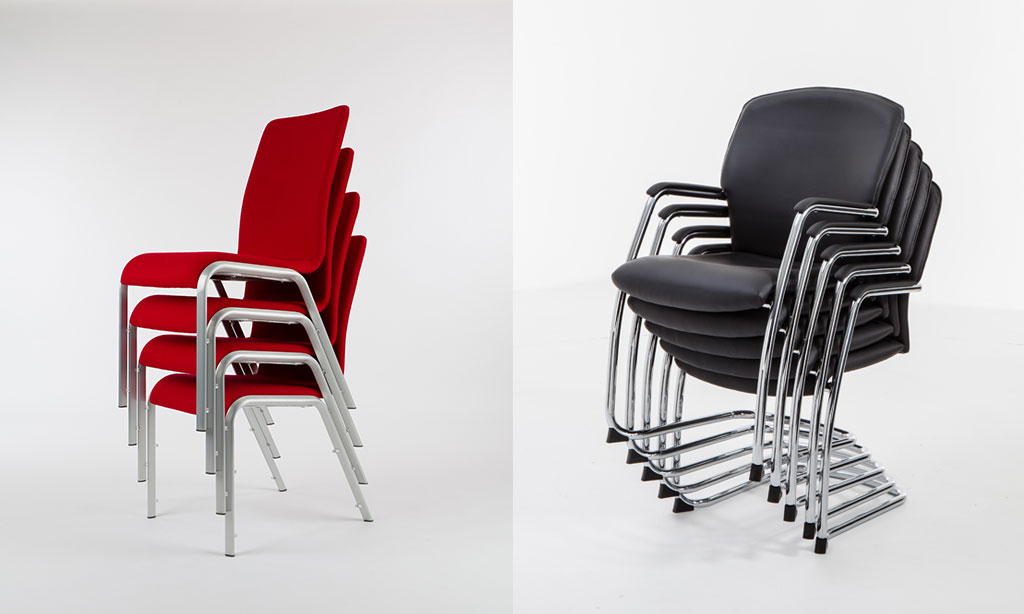
In these situations, stacking chairs are more than simple seating – they form part of the operational system that allows a room to change function quickly and efficiently.
The real advantage lies in how easily seating can be stored and redeployed. At our London showroom, we often demonstrate to venue managers how well-designed conference seating can be cleared within minutes simply by stacking and storing the chairs efficiently. That ability to reclaim space quickly is what allows multi-purpose venues to operate smoothly.
Where stacking chairs are used in real venues
The real test of a stacking chair rarely happens during the event itself. It happens afterwards, when staff are clearing the room, and the chairs need to be moved quickly, stacked safely, and stored neatly.
The practical benefits go well beyond the simple fact that they stack. A stack of 15 chairs may occupy little more floor space than one or two individual chairs, which is why vertical storage is so valuable in busy venues.
In venues that rely on flexible seating, a highly functional set of stacking chairs quietly solves several operational problems at once.

Faster room turnover
When chairs stack cleanly and move predictably, one person can do what used to take a team, especially with the right chair trolley.
Better storage discipline
Chairs that stack neatly are easier to keep organised. That might sound small, but it’s the difference between a storeroom that works and one that becomes more like a game of Jenga.
Simpler cleaning and maintenance
Stacking makes floor access easy, allowing venues to clear seating quickly for proper floor cleaning, something many hospitality and event teams rely on during daily resets.
Lower total cost of ownership
Well-built commercial stacking chairs are designed for repeated handling and long-term use, helping reduce replacement, repair and maintenance costs over time.
The trade-off is that stacking chairs are built for flexibility and repeat handling, not the kind of micro-adjustability you’d expect from an ergonomic task chair. The goal isn’t “custom fit”. The goal is comfort, durability and operational reliability at scale.
The two types of stacking chairs (and why the difference matters)
Most buyers assume “stacking is stacking”. In reality, there are two distinct systems and choosing the wrong one can make storage messy or damage upholstery.
1) Frame stacking (leg-on-leg)
Frame stacking chairs stack by resting the legs or frame on the chair below, often using stacking buffers to protect finishes and fabrics. This approach is common in banquet chairs, event chairs, conference stacking chairs and upholstered meeting seating.
Frame stacking is usually the better option when:
- you need a more formal look
- chairs will be stacked and unstacked constantly
- you want long-term durability in high-traffic spaces
- maximise storage capacity
2) Seat stacking (seat-on-seat)
Seat stacking chairs stack by nesting the seat or shell into the chair below. This approach is commonly seen in moulded or polypropylene seating and is often used in environments where practical handling and easy cleaning are priorities.
Seat stacking can work well when:
- chairs need to be cleaned quickly between uses
- lightweight handling is important
- simple, practical seating is preferred
- spaces require flexible, multi-purpose furniture
Some seat-stacking designs are also well suited to more contemporary hospitality, breakout and casual meeting environments.
Materials used in stacking chairs: what lasts, what’s practical, and what suits your venue
There’s no universal “best” material, it depends on how the chairs will be used, where they’ll be stored, and what guests expect to see and feel.
The materials used in stacking chairs influence durability, stacking height, maintenance and suitability for different environments.
| Material | Common Uses | Typical Stack Height | Maintenance | Suitable For |
|---|---|---|---|---|
| Polypropylene / Resin | Schools, breakout spaces, casual hospitality | Often 15-20 chairs | Very low – wipe clean | High-density storage, easy handling |
| Steel Frame | Banquet halls, conference venues, and hotels | Usually 5-10 chairs | Low | Durable indoor commercial use |
| Aluminium | Banquet halls, conference venues, and hotels | Around 10-15 chairs | Low | Lightweight handling, corrosion resistance |
| Wood | Restaurants, heritage venues | Typically 6-10 chairs | Medium | Design-led hospitality environments, low-use |
| Upholstered | Conference rooms, meeting spaces, and banqueting | Usually 10-15 chairs | Medium-high | Comfort-focused seating |
Polypropylene / resin (moulded stackable chairs)
Polypropylene chairs are popular for good reason: they’re lightweight, easy to clean, and usually simple to move and stack. They suit education, casual hospitality, breakout spaces and multi-use rooms. Some designs are appropriate outdoors, but always be sure to check UV resistance and environmental ratings for your climate.
Metal stacking chairs (steel and aluminium)
Metal frames are the workhorse option for busy venues. Metal stacking chairs are common in hotels, banqueting, conferences and event spaces because they handle repeated stacking and transport well when built properly.
Steel frames often deliver the best stability and “solid feel” indoors. Aluminium can be a good option where corrosion resistance and lighter handling matter. For example, warmer or coastal environments, or venues that frequently move chairs between indoor and outdoor settings.
In busy conference centres and hotels, metal stacking chairs often become the quiet backbone of the venue, handled frequently without issue.
Wood (stackable dining chairs and heritage looks)
Wooden stackable chairs can look fantastic in restaurants and hospitality interiors, but they need quality construction and sensible storage conditions. If a venue is humid, dusty or prone to rough handling, wood can show wear faster. However, if a wood look is high on the priority list, techniques have been developed to create a wood grain finish over a metal frame.
Upholstery (comfort, presentation, and realistic maintenance)
Upholstery changes the perception of a space immediately. It’s a big reason banquet chairs remain the default for weddings and formal events. But upholstery also introduces cleaning and storage considerations, and the most common mistake is selecting fabric without a realistic plan for maintenance.
Chair fabric choices offer more design flexibility but need consistent cleaning routines, especially in venues with food, drink or high turnover.
Understanding how materials affect durability and stacking performance can help venues make better long-term seating decisions.
Key takeaway
When choosing stacking chairs for hotels, conference venues and event spaces, focus on the factors that affect daily operation and long-term durability:
- Frame durability – chairs must withstand repeated stacking and transport
- Stable stacking design – prevents wobbling and protects upholstery
- Materials suited to the environment – steel, aluminium, polypropylene or wood, depending on the venue
- Ease of cleaning and maintenance – especially important in hospitality settings
- Compatibility with chair trolleys and storage systems
- Fire safety compliance – FR foams and upholstery fabrics should meet relevant UK and European standards for commercial hospitality furniture
Well-designed commercial stacking chairs in busy venues often remain in service for 10-15 years, making them one of the most reliable and cost-effective forms of contract furniture in hospitality environments.
What “commercial-grade” really means (and how to spot it quickly)
A commercial chair isn’t just “strong”. It’s designed to survive being moved, stacked, bumped, transported and used at scale.
When you’re assessing a chair, don’t just sit on it – handle it, stack it, move it, look underneath. This is where quality shows itself.
When evaluating commercial stacking chairs, these are the practical signs experienced venue operators and furniture manufacturers look for:
- Stable stance (no rocking, no flexing)
- Clean joins and consistent construction (especially on frames)
- Replaceable glides and protective components
- A stacking method that feels secure, not “hopeful”
- Finishes that won’t mark easily when stacked repeatedly
Small components matter more than buyers expect. Floor glides, stacking buffers and protective contact points are what stop frames from grinding against each other and stop floors from taking a beating over time. In busy venues, those details often decide whether chairs last.
Comfort and design: making stacking chairs feel “permanent”
One reason some venues dislike stacking chairs is the fear that they won’t look premium and, in some instances, will be a stopgap. But modern conference room chairs, meeting room chairs, and event chairs can look polished and intentional if the style, materials and finishes are chosen properly.
Comfort is also non-negotiable in many spaces. A banquet guest may sit for hours. A delegate attending a conference might be in a chair all day. A boardroom needs a professional feel. In these settings, look for supportive back shapes, sensible seat dimensions, and upholstery that matches the length of time people sit.
If you’re fitting out multiple spaces, for example, meeting rooms, conference rooms and flexible event areas, it can be worth choosing a small family of chairs that share a consistent design language. It keeps your venue looking cohesive while allowing for different performance requirements across rooms.
Practical features worth paying attention to
This is where furniture becomes easier to live with.
A few features can dramatically improve operations in real venues:
- Linking capability for neat rows in conferences and ceremonies
- Accessories allowing for writing surfaces to work on
- Handholds (or sensible grip points) to reduce staff strain
- Floor guides selected to suit the flooring environment and reduce surface wear over time
- Stacking buffers that protect finishes and upholstery
- Trolley compatibility (and trolley availability) for your chosen model
You don’t need every feature on every chair. But in high-turnover hospitality and conference environments, these details tend to pay for themselves.
How to stack and transport chairs safely (without damaging them)
Most chair damage doesn’t happen when guests are sitting down. By the end of a large event, teams are often clearing hundreds of chairs under time pressure, usually stacking them quickly and in tight spaces.
A few simple principles prevent most problems:
- Follow the recommended stack height (and reduce further when transporting)
- Stack on level ground and avoid high-traffic areas
- Never mix chair models in one stack – it creates instability and damage
- Use a chair trolley for the regular movement of multiple chairs
- Lift and place – don’t drop (especially with upholstered banquet chairs)
It’s worth saying plainly: dragging stacked chairs across the floor is one of the fastest ways to damage both the chairs and the flooring. In venues where chairs are moved every day, a trolley isn’t an optional extra – it’s an essential part of the seating system.
Cleaning and maintenance: keeping chairs presentable long-term
Chair trolleys are designed to make moving stacked chairs easily. However, do not be complacent and risk rushing or carrying too many. Here are steps to keep safe:
A good maintenance routine is less about effort and more about consistency. Small checks prevent bigger problems.
In most venues, a sensible routine looks like this:
- Regular wipe-downs of frames with mild cleaners
- Frequent vacuuming of upholstery in high-traffic spaces
- Prompt spot-cleaning for spills
- Periodic checks (every couple of months) for loose fixings, worn glides and missing buffers
The goal isn’t perfection, it’s preventing small issues from becoming “that chair everyone avoids”. Most venues don’t realise how much longer chairs can last when small issues like worn glides or loose fixings are caught early.
What to check when chairs arrive (the unglamorous step that saves headaches later)
When new chairs are delivered, it’s tempting to unwrap them and get them straight onto the floor. But a quick check at delivery can save a lot of back-and-forth later, especially for large orders.
We recommend:
- checking frames for damage or distortion
- verifying glides and stacking buffers are fitted
- stacking a small sample to confirm stability
- recording the model/spec details for reorders and maintenance
Those details become invaluable when a venue expands, refurbishes, or needs replacements years later.
FAQs
Stacking chairs help hotels, conference centres and event venues maximise space by allowing seating to be stored vertically when not in use. This enables faster room turnover, easier cleaning and more flexible layouts for meetings, conferences and events.
There is no difference in the actual products; it’s simply a different terminology. Both refer to chairs designed to stack vertically for storage.
Many are. Most commercial banquet chairs are designed to stack (usually frame stacking) and to work with trolleys for events and hospitality use.
Conference stacking chairs are designed for meeting and conference environments where seating must be rearranged frequently. They typically balance comfort, durability, and tidy stacking.
It depends on how the chairs will be used. Many commercial stacking chairs combine metal frames with polypropylene, upholstered or moulded seat designs. Steel and aluminium frames are widely used for durability in high-traffic venues, while polypropylene and wipe-clean surfaces can help simplify cleaning and maintenance. Upholstery adds comfort and a more formal appearance but requires ongoing care.
Stack height depends on the chair’s design, materials and frame strength. Lightweight moulded chairs may stack higher, while upholstered banquet or conference chairs typically stack lower to maintain stability and avoid compressing the cushions.
Always follow the manufacturer’s recommended stack height, as these limits are based on stability and safety testing.
Some stacking chairs on the market are designed specifically for outdoor use. However, most commercial stacking chairs used in hotels, conference venues and hospitality environments are intended for indoor use unless otherwise specified by the manufacturer.
Before using stacking chairs outdoors, always check the product specifications and environmental suitability guidance provided by the manufacturer.
Commercial stacking chairs are designed for repeated handling, stacking and transport. Signs of commercial-grade construction often include reinforced frames, replaceable floor glides, durable finishes and compliance with recognised furniture testing standards.
Venues purchasing large quantities of seating should always request product specifications and testing certifications before ordering.