
After nearly four decades with Burgess Furniture, Design Manager Peter Roth recently retired, marking the end of a remarkable chapter in the company’s design history. Peter’s influence can be seen across many of the products and innovations that have helped shape the Burgess range and reputation within the hospitality and events industry.
As Burgess looks ahead to the next phase of design and product development, we’re pleased to welcome Diggory Rush as our new Design Manager.

Diggory joins Burgess with a diverse and highly technical design background that spans Furniture Design, product engineering, art fabrication and the built environment. His experience ranges from developing anti-ligature devices for the mental health sector to creating large-scale artworks and retail environments for global brands. Alongside his industry work, he has also lectured in design engineering, Furniture Design and environmental design at several leading universities.
What connects this varied experience is a strong focus on design for manufacture, durability and practical use – principles that sit firmly at the heart of Burgess products.
We recently sat down with Diggory to talk about his design background, how he approaches hospitality furniture, and the trends shaping the industry today.
Below, he shares his thoughts on everything from balancing aesthetics with practicality to why flexibility, durability and thoughtful design matter more than ever in hospitality spaces.
Q&A with Burgess Design Manager Diggory Rush
Background & Design Experience
Tell us about your design background
I’ve got a multidisciplinary background and have always liked getting my hands dirty. I started out in Luthiery and R&D development for a well-known guitar pickup manufacturer that worked with some fairly heavy-hitting OEMs (Original Equipment Manufacturers). It gave me a great insight into design for manufacture, rapid prototyping and supply chain management. After that, I went on to study Furniture Design at the London School of Furniture Making and then Innovation Design Engineering at the RCA and Imperial College London, while taking on bespoke furniture commissions and design work. I’ve got multiple patents in my name, ranging from anisotropic smart materials to life-saving devices in the mental health sector.
Over the years, I’ve worked in sectors ranging from the mental health sector to high-end Art Fabrication. I have designed, prototyped and manufactured everything from anti-ligature devices for the North-American market, large sculptures for some of the biggest artists globally, retail stores for brands such as Nike and New Balance, performance staging, to productisation design for structural power composites for the aerospace industry. I’ve also worked as a Lecturer in MENG Design Engineering, MA Interior Design, BSC Furniture & Product Design and MA Environmental Design at Universities ranging from ICL, UCL (Bartlett), UCA, Kingston and XMU.
My work has been displayed at Design in Mental Health, London Design Festival, Clerkenwell Design Week, London Craft Week, Popular Mechanics Magazine, Bikebound, Soy Motero, The Great Exhibition Road Festival and NAMM. I have also collaborated with some of the most internationally recognised artists, brands and companies, including NASA and Nike. Having worked and lived across the globe, my work can be seen from Hong Kong to Detroit, MI.
What sectors have you worked in?
Product & Industrial Design, Furniture Design, Built Environment, Events & Art Fabrication
What type of projects are you most proud of?
A lot of the projects I’ve worked on are unfortunately under NDA’s, but one project I was always very proud of was a personal one.
I’ve always found that I need to keep up and develop my machining and fabrication skills, as well as the obligatory sketching and CAD modelling. It’s no use designing something if you have no idea how it will be made. With this in mind, in my evenings I decided to build a motorcycle, specifically a 7/11 Slingshot, essentially an 1100cc engine from the only bike ever banned at the TT into a smaller 750 frame, but I didn’t start with a bike, I bought just a frame and made what I call my Pick n’ Gixx, as no part on it is from the same bike, I machined, turned and tested all of it in my evenings after work. It was a real passion project: recycling, reusing, and deep-diving into kinematics.
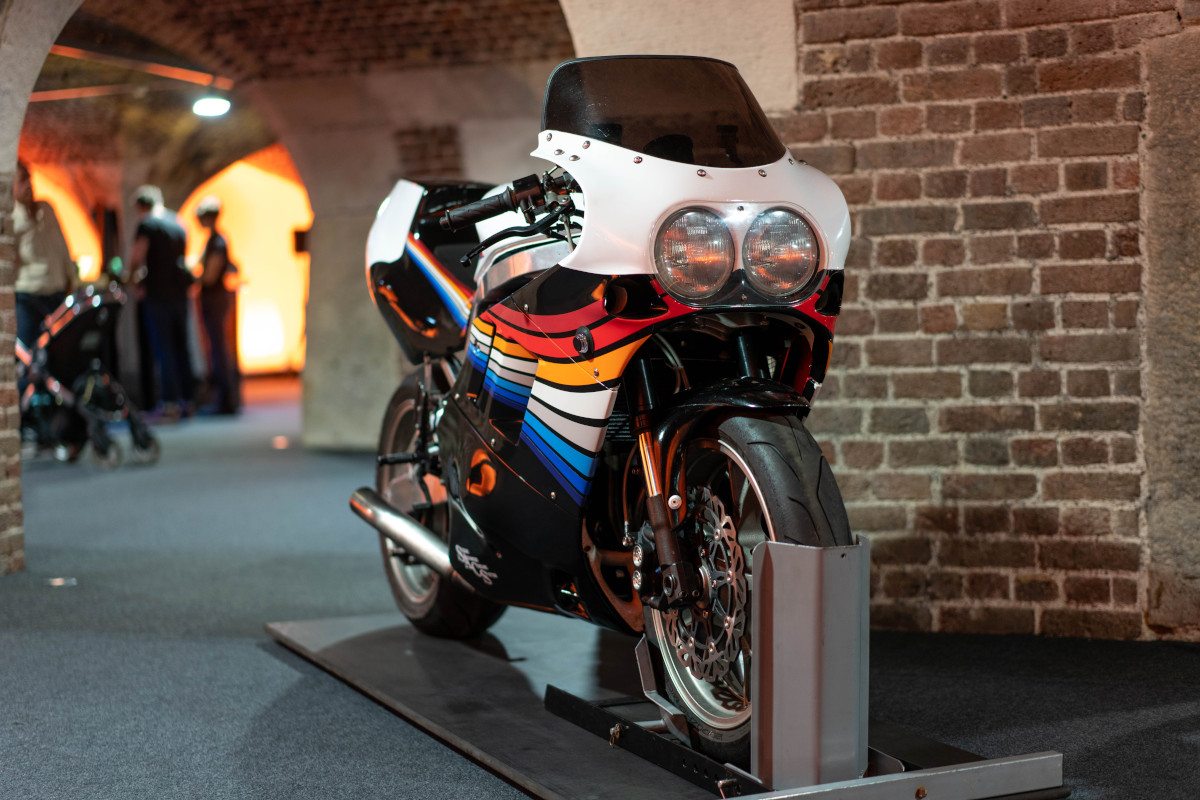
During the build, I was able to bring my full design and engineering expertise into the build, 3D-scanning parts, reverse-engineering and modelling changes in SolidWorks and Cinema 4D. In the end, I built the entire thing virtually, running Finite Element Analysis (FEA) and motion studies. I also bought a fair bit of unloved machinery to machine the billet aluminium parts I had designed. I had a 1920s IXL line-shaft lathe and a small bench-top mill, working out of a small council garage.
You can read more about my motorbike build here.
How would you describe your design philosophy?
I believe that now more than ever, we are in a period of reduction and reuse, we are doing away with short lifespan ‘trending’ products and viewing furniture and products in a more holistic manner. Globally, I believe we are going through a cultural change. The value of a product is now less defined by the initial purchase point and more by its role within a service model. Consumers and designers alike need to know that what we are buying/producing will last, be ethically and sustainably manufactured, and be supported throughout its lifecycle. The value proposition is less of a ‘hero’ image brochure sales pitch and instead a promise for a partnership and alignment of understanding of needs and requirements. There has to be an identification of a problem space, a market and a value proposition.
Two quotes I live by are ‘Less but Better’ and ‘Design is the Intermediary Between Information and Understanding’. I’d conclude by saying design isn’t always linear, fail fast and keep going.
Commercial Understanding
How do you balance aesthetics with practicality?
That’s a nice simple one, to quote an old design mantra, “Form follows function”. I value quality, longevity and cohesion within a design. Certain products are inherently utilitarian, but utilitarian design done right can be beautiful, if it’s considered. Think of the back of a Windsor chair (a classic), the notches are the maker’s mark, they connote its origin, but they also historically served the purpose of where you attached the pole lathe, they’re arguably one of the first mass produced lean manufactured pieces of furniture.
In short, no design for the sake of it, good design is timeless, and nothing is timeless by trying to follow a trend. With furniture, there’s a lot of CMF (Colour, Material & Finish), a lot of touch points and a lot of subtle design. Particularly in this industry, furniture should not be brash and ‘out there’, it’s a complementary item, part of a bigger vision for a space.
What are common mistakes venues make when selecting furniture?
They look in terms of numbers, how many covers can I get in and how many can I squeeze in this room. All valid considerations, but experience, safety and practicality should be the main goal. We have a great design team, that’s done this a lot, they know what works. We can tailor and help guide you through the journey. Speak to them, work out a layout with some ‘legs’. Leave the spreadsheet and decision matrix for later.
What makes furniture truly “fit for purpose” in hospitality?
It’s got to stand up to abuse and be intuitive. Hospitality is fast and, for furniture, unforgiving. I’ve got the benefit of having worked in a lot of event spaces, leading teams of agency staff. Turnarounds and resets are often very pressed for time, and I’ve seen how products fail. It’s not about ‘use it how it’s supposed to be used’, it’s making something engineered well enough that it can withstand how it needs to be used for its environment.
How does storage, durability and flexibility influence your design thinking?
Hospitality has been hit hard since the 2019 pandemic; business models and needs have changed, and spaces are now a lot more multipurpose than they historically were. This is now past the point of being reactionary; it’s necessary for growth and stability. Everything we design has to be strong, durable and flexible. We don’t ‘knock-out’ products based on requests, as they’ll be lacking in one of these areas. We require a level of rigour in our products to ensure they are relevant not just to where the industry is now, but also to where it is going. We need divergent thinking around a problem space, not an image of what someone would like.
Industry Trends
What trends are you currently seeing in hospitality design?
I see trends as part of the picture to form an insight into a reaction; they are often short-lived but a key area to identify. At the moment, I’d say there is a trend towards recycled material – i.e. not virgin – at a percentage in injection moulded/rotomolded products to offset their inherently fossil fuel-heavy production. This is a step in the right direction, and reflects a wider societal shift.
Are venues prioritising flexibility more than before?
Yes, I think this is a pattern that will continue, particularly as Gen Z are now prioritising wellness and health retreats over the more alcohol fuelled events. It changes the value proposition for evening entertainment spaces heavily for certain venues.
How is sustainability influencing furniture decisions?
Yes, you can clearly see it reflected in boutique brands aligning with designers and companies like Sebastian Cox. This is also being somewhat forced due to the global shortage of Russian birch plywood, which is an entire socio-economic and political issue I won’t go into.
Working with Clients
What do you believe clients value most in a design partner?
An understanding of their space, taking time to understand its operation and their business model. Not a cookie-cutter ‘we can give you X number of chairs at this unit cost with a two-year warranty’.
What makes a venue experience memorable?
Being able to focus on the experience, not thinking about that twinge in your lower back or the person who keeps bumping the back of your chair. We can’t do anything about the person one table over with a particularly shrill laugh, though, or the kid scrolling through reels at full volume.
If you could give one piece of advice to hospitality venues right now, what would it be?
Plan for flexibility and longevity; quick savings don’t play out. It’s the ‘price per wear’ mentality. This is not just about one brand, but a general philosophy.
Burgess & The Future
What excites you about designing within the Burgess range?
I can walk out onto the factory floor at any time. I get a huge amount of tacit knowledge shared by a large workforce of people proud of what they do. There’s no set we need X amount of products by this quarter; there’s an understanding that we just need to get it right. That’s rare, I’d say, even rarer than a company manufacturing fully in the UK.
Are there any particular products you’re excited to develop or champion?
That would be giving away a little too much at this stage, but I can see some problem spaces gaining some real traction. We’re a collaborative team, design is a process, and we’re just starting.
How do you see the Burgess brand evolving?
We have to move with the times; our manufacturing has changed significantly with Industry 4.0 and indeed 5.0. Supply chains are more stretched than ever before. Just think about how impactful the Evergreen disaster in the Suez Canal was. It has to be a period of innovation, and that is no bad thing.
In one sentence, how would you describe Burgess?
Craft mentality, production scale.
Personal Insight
What inspires your creativity?
For me, it’s always about solving problems. I want to map out user journeys, I want to fail fast, and I want to be part of a team that wakes up excited about what they are going to do that day. Being good-enough doesn’t cut it.
Outside of work, what influences your perspective?
’m lucky enough to be involved in the wider creative arts community. Whether it’s going to shows, or giving my time to young designers full of ideas, or helping small businesses or friends nail a launch or product pitch or that slight typography gripe.
In short, if I stayed in my own echosphere, my ideas would be stale; you have to be multidisciplinary and be willing to understand different perspectives.
For influences, I’d say: Burt Munro, Flamino Bertoni, Oluwaseyi Sosanya, Gareth Neal, Assa Ashuach & Poul Henningsen
Looking ahead
Diggory’s multidisciplinary approach and practical design mindset reflect the principles that have long defined Burgess. As the hospitality and events industry continues to evolve, his focus on durability, flexibility and thoughtful design will play an important role in shaping the next generation of Burgess products.